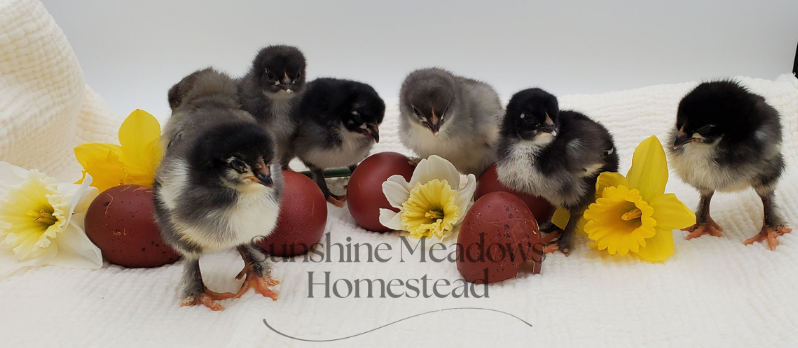
While hatching chicks from eggs is a very fun, rewarding process – hatching chicks from shipped eggs can be a bit more challenging. Because there are so many variables in the shipping process, by the time you open your box of eggs to set them in your incubator, there is no telling what may have happened to them along the way. I have hatched many hundreds of shipped eggs, and while I usually have a pretty high success rate following the directions below, there are still times where only 1 or 2 chicks have hatched for me out of a dozen or even two dozen shipped eggs. Most breeders test their hatching eggs regularly, and we are no exception to that rule. I am consistently setting eggs and hatching chicks from our own eggs, to ensure that our hatching eggs have the best fertility rates possible.
Choosing an Incubator
When you are choosing an incubator for shipped eggs, the best incubators are those that hold the eggs in an upright position, with the fat end up. Some of these choices could be the Maticoopx, Chickcozy or Brinsea incubators. Incubators like the NurtureRite 360 and other side-lying incubators are NOT good options for shipped eggs, or for any eggs really, as their temperature and humidity are very inconsistent. Please DO NOT use a cabinet incubator, unless you have confidently done shipped eggs with a great success rate previously and know how to manage them. Temperature and humidity are very inconsistent in cabinet incubators, and this can cause a low success rate. I have had seasoned hatchers who do their own eggs in cabinet incubators, but have very poor hatch rates in them from shipped eggs.
Keeping track of Temp & Humidity
Many incubators have automatic sensors for temperature and humidity control, but that does not mean they are accurate. And if they are accurate, they can sometimes become defective or tired during the incubation process, and stop working properly. To avoid this, I highly recommend getting a “Govee” brand thermometer/hygrometer and placing it in the incubator to double check the readings on the incubator. With the Govee thermometer, you can cross examine your incubator and adjust as needed. This is CRITICAL, as variations in temperature and humidity beyond the small amount of variance can make all the difference between healthy chicks, or those that don’t make it for one reason or another.
Directions for Incubation & Hatching
With the proper incubator and temperature/humidity control in place, you’re now ready to set your eggs! Be sure you have the incubator turned on and up to temp/humidity for about 12-24 hours before your eggs arrive. I like to run my incubators between 100.0-100.5 F and humidity between 40-50% straight through hatching. The temperature being just a tad higher, and a consistent humidity, seem to work really well for me. I have found that raising the humidity during lockdown causes chicks to drown for me, so these are the setting I use, personally.
● If your eggs are arriving during a warmer time of year, take them directly from the box and add them into the incubator, fat side up. I do this because if your eggs have possibly reached 100*F at any time during travel, they may have possibly started growing already. Popping them directly into the incubator will give them the best chance of continuing that growth.
● If your eggs are arriving during a colder time of year (below 55-60*) it’s best to take them out of the packaging and set them in an egg carton (fat side up) and let them rest for 8-24 hours to bring them up to ambient temperature before adding them into the incubator. When you are unpacking your eggs, it’s best to always keep them in an upright position and avoid setting them on their sides. During shipping sometimes the air sacs become detached, and holding them in different positions can have a negative impact on them.
● It’s a lot of fun to candle eggs — however, I discourage candling of shipped eggs, as it can disrupt a super fragile embryo or re-orient a loose air cell. For best hatch rates, I do not candle shipped eggs until day 18 when I am putting them into lockdown. This is the time you will take the eggs out of the carriages and gently set them on their sides inside the incubator. At this point, any eggs that have not ‘sprouted’ or developed, I toss. For candling shipped eggs on day 18, I always candle them in the upright position, avoiding rocking them back and forth, or any motion that may re-orient the contents inside the egg. (baby chick, air sac, etc.)
● Watch them hatch! This is a very fun experience, watching new life burst from egg shells. Keep in mind it can take 24 hours or more from the time you see the first pip in the egg shell until the time the chick emerges. This is a long, tiring process for a baby chick, and they take a lot of breaks. At this point they are still being fed from their little yolk sac they continue to absorb and draw energy from – and will continue to do this for a couple days after hatch, which gives them the time they need to start eating and drinking on their own.
● Chick abnormalities — We all like to hatch healthy chicks that are little fluffy balls of energy and can pop around on their own, learning all the new chick things. However, sometimes things don’t go as planned and there are difficulties that have to be overcome. Sometimes this is due to incubation anomalies such as too high or low of temperature or humidity, or too much variation; or sometimes it can be due to things that happen to the embryo during shipping that are beyond our control. Sometimes a chick hatches a little weaker than normal, and may need a little bit of help getting going. Splayed legs, for example, are an anomaly that can be fixed but must be done within the first day or so after hatch, before the leg tendons harden and it becomes more difficult. There are many articles online with many ways of helping chicks that need a little extra attention, and although this is rare, it’s good to be aware of these things in case you notice something out of the ordinary with a chick that may need a little extra attention.